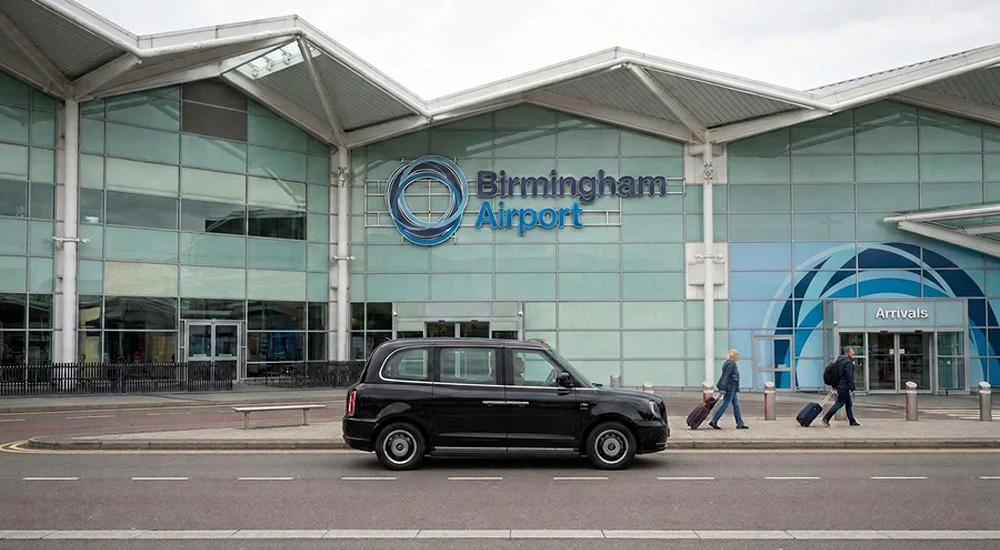
How people travel to Birmingham Airport is no longer guesswork. The Civil Aviation Authority’s 2025 passenger survey, published on 7 October 2026, found that 47.3% of passengers arrived by private car, 32.6% by taxi, minicab or Uber, and 14.8% by rail. That was the highest taxi, minicab and Uber share of the eight English airports surveyed.
This guide sets out the full breakdown for Birmingham, compares it with other airports and shows how the taxi share has moved since 2010. It also explains what the figures can’t tell you, because a share of passengers isn’t a share of taxi journeys, and what that means when you choose how to get to the airport.
Figures come from the CAA’s published Table 6.2 and Table 7.1 for 2025, and its 2023 table. Details last checked on 30 October 2026.
How people travel to Birmingham Airport: the 2025 CAA breakdown
| Last surface mode | Share of passengers |
|---|---|
| Private car | 47.3% |
| Taxi, minicab or Uber | 32.6% |
| Rail | 14.8% |
| Bus or coach | 2.7% |
| Hire car | 1.1% |
| Other | 1.4% |
| Tube, metro or tram | 0.0% |
The CAA calls this the “last surface mode”, meaning the final form of transport used to reach the airport. Its own Table 6 lists the Birmingham figures above. The shares are rounded, so they total 99.9%.
Four in five passengers arrived by road in a car or taxi. Adding private car, taxi and hire car gives 81.0%. Rail and bus together account for 17.5%, which is well below the 38% public transport share across all eight airports surveyed.
How the survey works
The CAA interviewed about 175,000 departing passengers at eight English airports during 2025. Passengers were approached at the gate and asked around 30 questions, including how they reached the airport. The CAA then weighted the answers against actual departing passenger numbers.
How Birmingham compares with other airports
The table shows the same CAA measure for all eight airports. Rail, bus and Tube figures help explain the differences, because public transport varies widely.
| Airport | Taxi, minicab or Uber | Private car | Rail | Bus or coach | Tube or metro |
|---|---|---|---|---|---|
| Birmingham | 32.6% | 47.3% | 14.8% | 2.7% | 0.0% |
| Heathrow | 31.2% | 24.7% | 4.4% | 10.2% | 27.2% |
| Manchester | 30.1% | 48.6% | 16.4% | 2.4% | 0.8% |
| London City | 27.8% | 6.5% | 0.0% | 2.0% | 62.6% |
| East Midlands | 23.3% | 66.2% | 0.0% | 9.4% | 0.0% |
| Luton | 19.3% | 45.6% | 24.2% | 9.8% | 0.0% |
| Gatwick | 14.0% | 41.6% | 38.7% | 5.0% | 0.0% |
| Stansted | 10.0% | 40.5% | 33.6% | 14.4% | 0.1% |
Birmingham has the highest taxi share, followed by Heathrow and Manchester. Its private car share is close to Manchester’s, and its rail share is a little lower. East Midlands stands out at the other extreme, with two in three passengers arriving by car and no rail use recorded.
Don’t read too much into the Heathrow and London City figures. Both have Tube or metro links that take a large share of passengers, so their taxi shares sit alongside a different mix.
How the taxi share at Birmingham has changed
The CAA publishes the same table every year. Its 2023 table gives Birmingham’s taxi, minicab and Uber share as 32.5%, and trade press puts 2024 at about 33%. Earlier figures come from Birmingham Airport’s own Airport Surface Access Strategy, published in 2023, which draws on CAA survey data and the airport’s own monitoring.
| Year | Taxi share | Private car share | Source |
|---|---|---|---|
| 2010 | 21.0% | 60.6% | Airport strategy |
| 2016 | 21.5% | 50.5% | Airport strategy |
| 2019 | 27.9% | 51.6% | Airport strategy |
| 2021 | 21.3% | 65.5% | Airport strategy |
| 2022 | 33.9% | 48.3% | Airport strategy |
| 2023 | 32.5% | 46.2% | CAA Table 6.2 |
| 2025 | 32.6% | 47.3% | CAA Table 6.2 |
On the figures available, about a third of passengers have used a taxi, minicab or Uber every year since 2022. Rail has stayed close to 15%, at 15.1% in 2023 and 14.8% in 2025. The 2021 figures reflect the pandemic, when far fewer people flew and the mix changed. Categories differ slightly between sources, so compare the trend, not the decimals.
How the airport’s targets compare
The 2023 strategy set 2028 targets of 46% for car, 29% for taxi and 25% for public transport and active travel. The 2025 survey shows 47.3% by car, 32.6% by taxi and 17.5% by rail and bus. The categories aren’t identical, so treat this as a rough comparison. Even so, taxi and car use sit above the targets, and public transport sits below.
What the 32.6% does and doesn’t mean
It counts passengers, not taxi journeys
The CAA measures passengers. A taxi carrying a couple counts twice. Table 7.1 shows how Birmingham passengers travel: 29.5% alone, 49.2% with one other person, 9.0% with two others and 7.4% with three others. Another 2.0% travel with four others, and 2.9% with five or more.
That means 70.5% of passengers travel with at least one other person. The table covers all passengers, not taxi users alone. Even so, the share of taxis and cars on the road is likely smaller than the share of passengers, and you can’t turn 32.6% into a number of vehicle trips.
It doesn’t separate pre-booked taxis from the rank
The CAA groups taxis, minicabs and Uber together. The survey can’t tell you how many passengers used a black cab from the rank, a pre-booked private hire car or an app. Our guide to the BHX taxi rank and pre-booked taxis explains how those options differ.
The car category covers more than driving yourself
The airport’s strategy treats both parking and being dropped off by someone else as private car trips. The 47.3% therefore includes friends and relatives doing the drop-off. The survey doesn’t say how many chose each, so it can’t show how much the airport’s charges change behaviour.
It records the final mode only
Someone who takes a train to Birmingham International and then a taxi to the terminal counts as a taxi user. The survey tells you what happened on the last leg, not the whole journey.
Who is travelling: business and leisure
Table 7.1 also shows who flies from Birmingham. UK leisure passengers make up about 79% of the 13.1 million passengers counted. UK and foreign business passengers together make up about 11%, in line with the airport’s 11% business share reported elsewhere.
Group size differs sharply by type of trip. Among UK business passengers, 82.8% travel alone. Among UK leisure passengers, only 19.2% travel alone, and 56.0% travel as a pair. The survey doesn’t link group size to the mode used, so it can’t prove that families choose taxis. It does show that most leisure passengers share a vehicle with someone, which is when splitting a fare makes sense.
Why so many Birmingham passengers choose a taxi
The CAA doesn’t ask why people choose a mode, so the survey can’t answer this. The data and public information point to a few practical factors:
- Group size: with 70.5% of passengers travelling together, a shared vehicle spreads the cost.
- Luggage: leisure travellers make up most passengers and often carry checked bags.
- Early and late flights: the airport says taxis and private hire are available 24 hours a day, which suits unusual flight times.
- Charges for other options: Premium Set Down is a paid zone, and the free Drop Off car park only allows 10 free minutes. Our Birmingham Airport drop-off charges guide explains the options.
These are explanations, not survey findings. Different passengers choose a taxi for different reasons.
Choosing how to get to Birmingham Airport
The right option depends on your journey, not on the average. The table matches common situations to the modes the survey records.
| Your situation | Option that often fits | Why |
|---|---|---|
| Solo traveller, light bag, near a station | Rail and the Air-Rail Link | Birmingham International connects to the terminal by a free people mover |
| Couple or family with luggage | Pre-booked taxi, or car and parking | You share the cost across the party |
| Very early or late flight | Pre-booked taxi | Available around the clock |
| A quick goodbye with a friend driving | Drop Off car park | Free for the first 10 minutes |
| Business traveller | Pre-booked taxi at a fixed fare | The price and pickup time are agreed in advance |
| Group of five to seven | One larger vehicle | One fare and one pickup |
If a taxi looks like the better fit, our Birmingham Airport transfers page explains how a pre-booked taxi works, with a fixed fare agreed when you book. For larger parties, the Mercedes V-Class takes up to seven passengers.
What could change how people reach the airport
Birmingham Airport published a £2bn draft master plan on 8 October 2026. It aims to handle about 30 million passengers a year by 2041, up from 13.65 million in 2025. The plan includes improvements to surface access, and the airport has opened a public consultation.
The plan is a proposal, not a decision, and a final plan would follow the consultation. Changes to rail, bus or road access could affect how passengers choose to travel. The CAA’s next annual survey will show whether they do.
Book your Birmingham Airport taxi
NET Airport Transfers runs pre-booked, fixed-fare taxis to and from Birmingham Airport, 24 hours a day. Tell us your flight time, pickup address, group size and luggage, and we’ll plan your journey. Book your Birmingham Airport taxi online.
Related Articles
- Taxi vs Public Transport in Birmingham: A Fair Comparison
- School Holiday Airport Taxi from Birmingham: When to Book
- Ryanair Bag Drop Closes 60 Minutes Before Departure from 10 November: When to Book Your Birmingham Airport Taxi
Frequently Asked Questions
How do most people travel to Birmingham Airport?
By private car. The CAA’s 2025 survey found 47.3% of passengers used a private car, 32.6% a taxi, minicab or Uber, and 14.8% rail.
What percentage of passengers take a taxi to Birmingham Airport?
32.6% used a taxi, minicab or Uber in 2025. That was the highest share of the eight English airports surveyed, ahead of Heathrow at 31.2% and Manchester at 30.1%.
Does 32.6% mean one in three taxi journeys?
No. The CAA counts passengers, and 70.5% of Birmingham passengers travel with at least one other person. A shared taxi therefore carries several passengers, so the share of vehicles is likely lower.
Does the survey separate pre-booked taxis from the taxi rank?
No. The CAA groups taxis, minicabs and Uber into one category, so it can’t show how many passengers used a rank, a pre-booked car or an app.
How many passengers travel to Birmingham Airport by train?
14.8% arrived by rail in 2025, close to the 15.1% recorded in 2023. Birmingham International station connects to the terminal by the free Air-Rail Link.
How does Birmingham compare with Heathrow and Manchester?
Birmingham’s taxi share is 32.6%, against 31.2% at Heathrow and 30.1% at Manchester. Birmingham’s private car share of 47.3% is close to Manchester’s 48.6%.
Who collects the data?
The UK Civil Aviation Authority. It interviewed about 175,000 departing passengers at eight English airports in 2025 and published the results on 7 October 2026.
Is the Air-Rail Link free?
Yes. It’s a free people mover between Birmingham International station and the terminal, so you don’t need a taxi or bus for that stretch.